Formation & Purpose
The Hague Group is a coalition of nations from the Global South formed on January 31, 2025, to protect and uphold the rulings of the International Court of Justice (ICJ) and the International Criminal Court (ICC) — both located in The Hague, Netherlands — in relation to the Israeli–Palestinian conflict. The group was convened by Progressive International. Wikipedia
Founding Members
The founding members are Belize, Bolivia, Colombia, Cuba, Honduras, Malaysia, Namibia, Senegal, and South Africa. Middle East Eye. However, within one month of founding, Belize withdrew from the group. Wikipedia
Expanded Participation
The group has grown significantly beyond its founding core. On September 26, 2025, during Netanyahu's speech at the 80th UN General Assembly, the Hague Group convened a ministerial meeting of 34 countries — the core member states plus Algeria, Antigua and Barbuda, Brazil, Chile, Comoros, Djibouti, Guyana, Iceland, Indonesia, Iraq, Ireland, Jordan, Kuwait, Maldives, Mexico, Nicaragua, Norway, Oman, Palestine, Qatar, Saint Vincent and the Grenadines, Saudi Arabia, Slovenia, Spain, Turkey, Uruguay, and Venezuela.
It's worth noting that there's a distinction between full member states and countries that participate in meetings or have endorsed specific measures — the group doesn't publish a precise, formal membership list, so the lines between "members" and "participating states" can be a bit fluid. The core founding bloc remains the eight original nations, with a much broader coalition of 30+ countries now engaging with the group's agenda.
Key Commitments
Member states agreed to prevent the provision or transfer of weapons, ammunition, and related equipment to Israel in cases where there is a clear risk those weapons would be used to commit violations of international humanitarian law or genocide. They also announced they would prevent ships used to transport weapons or military fuel to Israel from docking at their ports.
Recent Activity
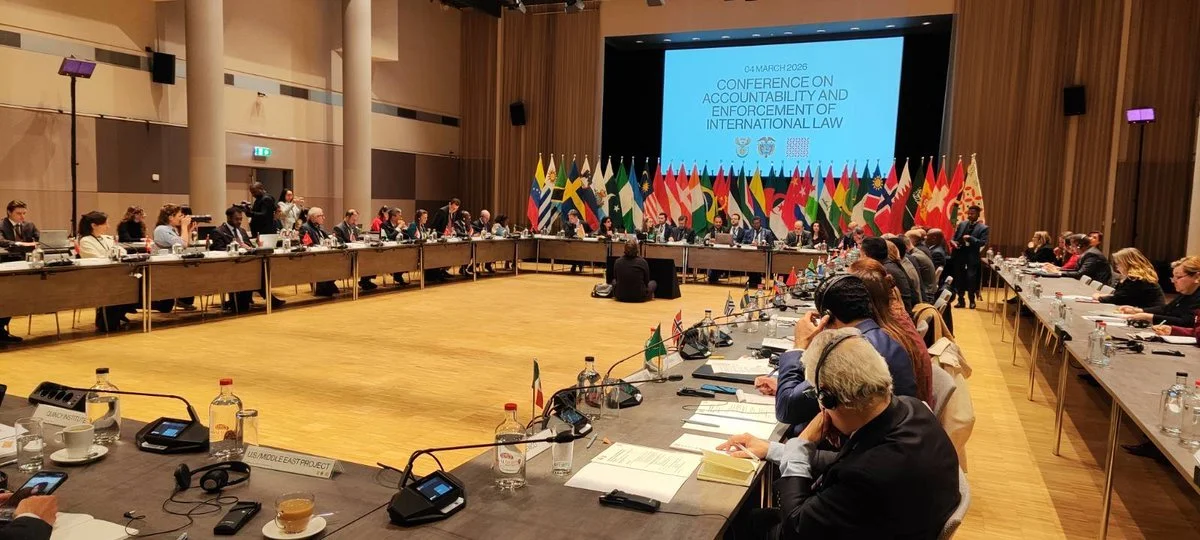
South Africa and Colombia, as co-chairs, invited governments from around the world to meet in The Hague on March 4, 2026 with the aim of pushing for coordinated and concrete actions to end impunity, halt complicity, and enforce international law. Sada News Agency.
Context & Criticism
The group emerged against a backdrop of frustration with Western nations' responses to ICJ and ICC rulings. The absence of Arab and European states — including traditionally vocal actors like Ireland and Spain — is notable, reflecting the fact that upholding international law has become increasingly politicized and costly, particularly under US diplomatic pressure.
The group is a significant and evolving development in international law and geopolitics, representing a coordinated push by Global South nations to enforce international legal norms independently of Western-led institutions.
In the face of continued absence of accountability for Israel’s unlawful actions, participants reaffirmed their commitment to ensure accountability for the most serious crimes under international law through appropriate, fair and independent investigations and prosecutions. In light of these urgent concerns, the leaders presented concrete measures, drawn from third-party state legal obligations as determined by the International Court of Justice’s Advisory Opinion of July 2024 and the United Nations General Assembly Resolution ES-10/24 of September 2024, to be further developed and formally tabled at an upcoming ministerial meeting, due to be announced shortly, including:
I. Ensure Accountability: No Safe Haven for Perpetrators of Genocide, War Crimes, Crimes Against Humanity, and the Crime of Aggression
Implement a disclosure requirement regarding service in the Israeli military subjecting travelers with Israeli travel documents or arriving from an origin of Tel Aviv airport to potential secondary screening at ports of entry under domestic war-crimes inadmissibility rules, and/or adjusted visa policies, as applicable; in compliance with the obligation to ensure accountability for the most serious crimes under international law through robust, impartial and independent investigations and prosecutions at national or international levels, and ensure justice for all victims and the prevention of future crimes.
II.Enforce Non-Recognition of Illegal Settlements
Refuse to recognize settlements as legally valid, and prohibit the import of settlement goods and prevent domestic companies from operating in settlements, ensuring that no national, company, or entity under participating states’ jurisdiction lends recognition or material support to Israel’s unlawful presence.
III.Cut Complicity: No Arms or Material Support
Prevent the transfer, transit, or carriage of arms, munitions, military fuel, and dual-use items to Israel — including through export restrictions, port controls, and flag-state responsibilities — in full compliance with international law. Conduct urgent reviews of public procurement and contracts to ensure that no public institution or public funds sustain Israel’s unlawful occupation. The choice before every government is clear: complicity or compliance. History will judge us not by the speeches we delivered, but by the actions we took. H.E. Alvin Botes Deputy Minister